

- Cryptocurrencies all
- Are all cryptocurrencies based on blockchain
- Market cap of all cryptocurrencies
Cryptocurrencies all
The thing to understand is that some cryptocurrency platforms are not intended to be used as daily monetary systems. As such, you would not expect them to enjoy widespread acceptance among consumers and merchants https://ritzycruises.com/live-casino/live-blackjack/. These types of cryptocurrencies serve some other purpose.
You might have a project that utilizes blockchain technology to control the flow of goods. We can imagine a shipping company here. They have developed a blockchain program for logistics management, a program that relies on the creation and transfer of tokens in order to keep track of inventory.
Most people are not aware that there is a difference between digital, virtual, and cryptocurrencies, but they are strongly related, and it’s not a huge mistake when we mix them up. But, here we are to explain it. Digital currencies are the main group that contains all the electronic money, including the virtual and crypto ones. Virtual money is strictly digital, they aren’t controlled by any bank, and they exist in some virtual spaces, and can be used there. Sometimes, they can be exchanged for traditional money, depending on the purpose and the background. But, what makes the cryptocurrencies different? They are both digital and virtual, but they are backed up by cryptography. In order to access them, you need to either invest in the blockchain system and solve advanced cryptography tasks or join some trading community, and buy or exchange them from the people who already mined their money, and they are ready to sell them for cash. Interested?
Tokens are not currency at all, though they can represent units of value. Instead, tokens are a form of programmable asset specifically used to create and execute smart contracts. When a token represents a unit of value, it can stand in to represent physical or digital assets, including cryptocurrency, though it is not a unit of currency in its own right. Basically, if you own a token representing an asset, you own a blockchain-verified smart contract connected to the asset in question.

Cryptocurrencies all
Welcome to CoinMarketCap.com! This site was founded in May 2013 by Brandon Chez to provide up-to-date cryptocurrency prices, charts and data about the emerging cryptocurrency markets. Since then, the world of blockchain and cryptocurrency has grown exponentially and we are very proud to have grown with it. We take our data very seriously and we do not change our data to fit any narrative: we stand for accurately, timely and unbiased information.
Each of our coin data pages has a graph that shows both the current and historic price information for the coin or token. Normally, the graph starts at the launch of the asset, but it is possible to select specific to and from dates to customize the chart to your own needs. These charts and their information are free to visitors of our website. The most experienced and professional traders often choose to use the best crypto API on the market. Our API enables millions of calls to track current prices and to also investigate historic prices and is used by some of the largest crypto exchanges and financial institutions in the world. CoinMarketCap also provides data about the most successful traders for you to monitor. We also provide data about the latest trending cryptos and trending DEX pairs.
At the time of writing, we estimate that there are more than 2 million pairs being traded, made up of coins, tokens and projects in the global coin market. As mentioned above, we have a due diligence process that we apply to new coins before they are listed. This process controls how many of the cryptocurrencies from the global market are represented on our site.
Cryptocurrency market capitalization (market cap) refers to the total value of a particular cryptocurrency that is currently in circulation. It is calculated by multiplying the current market price of a cryptocurrency by the total number of coins or tokens that have been issued. The total market capitalization of all cryptocurrencies for today is $3,482,102,116,442
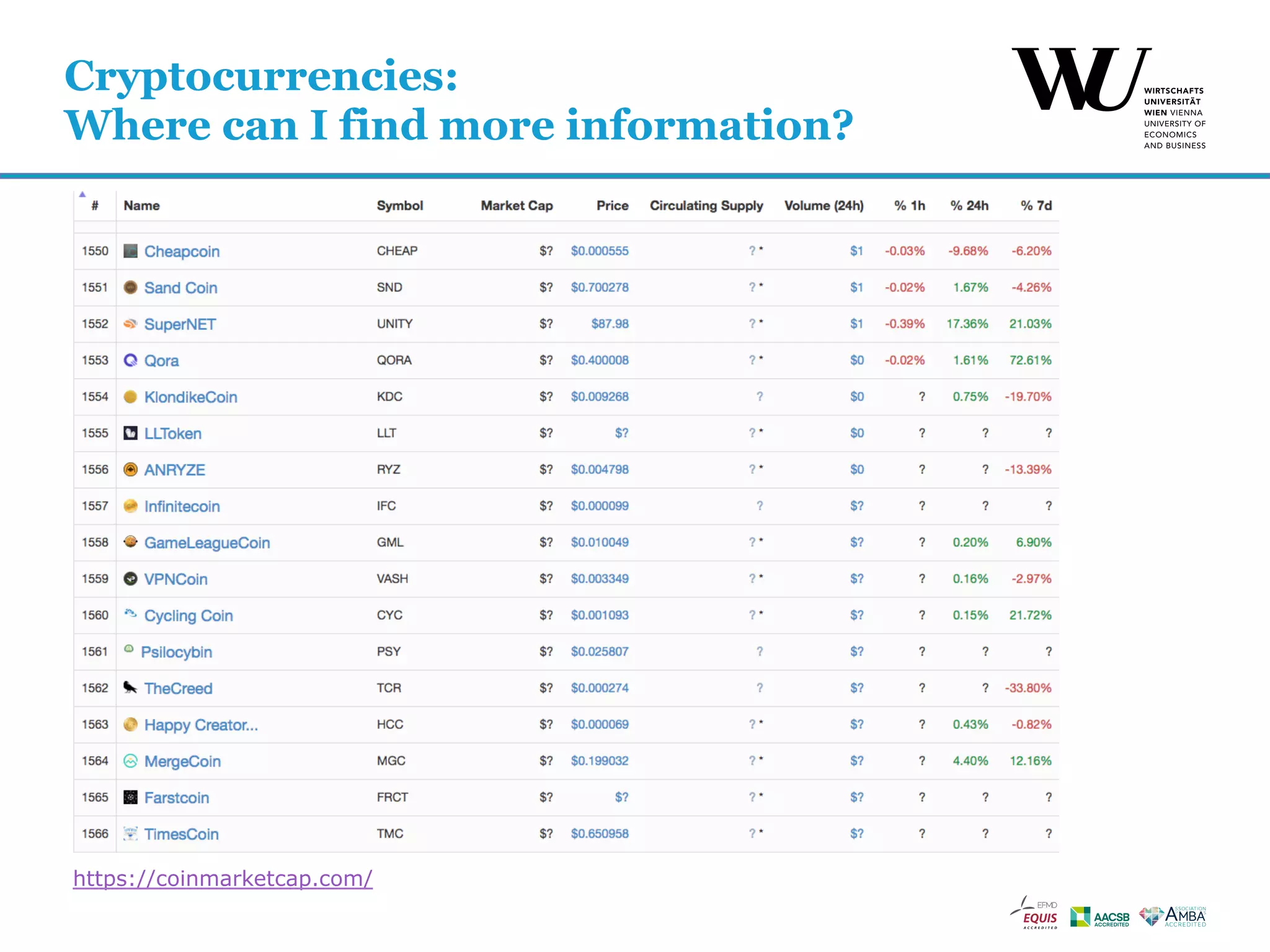
These crypto coins have their own blockchains which use proof of work mining or proof of stake in some form. They are listed with the largest coin by market capitalization first and then in descending order. To reorder the list, just click on one of the column headers, for example, 7d, and the list will be reordered to show the highest or lowest coins first.
Are all cryptocurrencies based on blockchain
A consensus algorithm is the third component. And last but not least, there is the issue of punishment and reward. Game Theory is where the latter comes from. It ensures that people will always follow the rules in their best interests. Each time users establish a consensus and add a new block to the chain, they receive a token or coin. Punishment for bad actors, on the other hand, is a loss of money spent on computational power.
Perhaps the most profound facet of blockchain and cryptocurrency is the ability for anyone, regardless of ethnicity, gender, location, or cultural background, to use it. According to The World Bank, an estimated 1.4 billion adults do not have bank accounts or any means of storing their money or wealth. Moreover, nearly all of these individuals live in developing countries where the economy is in its infancy and entirely dependent on cash.
Transactions placed through a central authority can take up to a few days to settle. If you attempt to deposit a check on Friday evening, for example, you may not actually see funds in your account until Monday morning. Financial institutions operate during business hours, usually five days a week—but a blockchain runs 24 hours a day, seven days a week, and 365 days a year.
Every node in the network proposes its own blocks in this way because they all choose different transactions. Each works on their own blocks, trying to find a solution to the difficulty target, using the “nonce,” short for number used once.
A consensus algorithm is the third component. And last but not least, there is the issue of punishment and reward. Game Theory is where the latter comes from. It ensures that people will always follow the rules in their best interests. Each time users establish a consensus and add a new block to the chain, they receive a token or coin. Punishment for bad actors, on the other hand, is a loss of money spent on computational power.
Perhaps the most profound facet of blockchain and cryptocurrency is the ability for anyone, regardless of ethnicity, gender, location, or cultural background, to use it. According to The World Bank, an estimated 1.4 billion adults do not have bank accounts or any means of storing their money or wealth. Moreover, nearly all of these individuals live in developing countries where the economy is in its infancy and entirely dependent on cash.
Market cap of all cryptocurrencies
Let’s say that a company creates Stablecoin X (SCX), which is designed to trade as closely to $1 as possible at all times. The company will hold USD reserves equal to the number of SCX tokens in circulation, and will provide users the option to redeem 1 SCX token for $1. If the price of SCX is lower than $1, demand for SCX will increase because traders will buy it and redeem it for a profit. This will drive the price of SCX back towards $1.
A stablecoin is a crypto asset that maintains a stable value regardless of market conditions. This is most commonly achieved by pegging the stablecoin to a specific fiat currency such as the US dollar. Stablecoins are useful because they can still be transacted on blockchain networks while avoiding the price volatility of “normal” cryptocurrencies such as Bitcoin and Ethereum. Outside of stablecoins, cryptocurrency prices can change rapidly, and it’s not uncommon to see the crypto market gain or lose more than 10% in a single day.
The total crypto market volume over the last 24 hours is $172.65B, which makes a 34.94% increase. The total volume in DeFi is currently $27.22B, 15.77% of the total crypto market 24-hour volume. The volume of all stable coins is now $161.34B, which is 93.45% of the total crypto market 24-hour volume.
Generally, cryptocurrency price data will be more reliable for the most popular cryptocurrencies. Cryptocurrencies such as Bitcoin and Ethereum enjoy high levels of liquidity and trade at similar rates regardless of which specific cryptocurrency exchange you’re looking at. A liquid market has many participants and a lot of trading volume – in practice, this means that your trades will execute quickly and at a predictable price. In an illiquid market, you might have to wait for a while before someone is willing to take the other side of your trade, and the price could even be affected significantly by your order.
With a blockchain, it’s possible for participants from across the world to verify and agree on the current state of the ledger. Blockchain was invented by Satoshi Nakamoto for the purposes of Bitcoin. Other developers have expanded upon Satoshi Nakamoto’s idea and created new types of blockchains – in fact, blockchains also have several uses outside of cryptocurrencies.